


 +1 617 404 2125


Bali Tourism Statistics: 2025–2026 Arrivals & Trends


BY Gede
12 days ago


Bali Tourism Statistics at a Glance (2025–2026)
Last updated October 17, 2026. The latest annual figures available show that Bali recorded 6,948,754 direct international tourist arrivals in 2025, up 9.72% from 2024. The latest monthly snapshot published by Bali’s official statistics agency covers August 2026: 685,994 direct foreign arrivals. Australia remained the largest source market in both periods. The figures below distinguish annual totals from a single month so you can understand what the numbers do—and do not—say about travel demand.
Reading note: The original sections and charts below report 2023 data. They are retained as a historical baseline, not presented as current 2026 statistics. The older commentary on economic impact and future growth below is general context, not a measured conclusion established by those arrival counts. Arrival counts measure recorded direct foreign visits to Bali; they are not the same as domestic trips, hotel guests, unique individuals, visitor spending, or Bali’s total tourism contribution.
Latest official Bali tourism figures
- 2025 annual arrivals: 6,948,754 direct foreign tourist visits, 9.72% higher than 2024. Visitors holding Australian passports accounted for 23.44% of the year’s total. BPS Bali’s 2025 annual summary.
- August 2026 arrivals: 685,994 direct foreign visits, down 1.69% from 697,809 in July. Australian passport holders represented 23.51% of August arrivals. BPS Bali’s August 2026 tourism release.
- August 2026 hotel occupancy: star-rated hotels recorded 68.19%, up 0.90 percentage points from July but down 1.34 points year over year; non-star hotels and other accommodation recorded 43.16%, up 0.63 points month over month.
These measures answer different questions: arrivals show international demand entering the island, while occupancy reflects rooms filled in a particular accommodation category. Neither alone tells you whether a specific beach, town, attraction, or hotel will feel crowded. For destination context, start with our Bali travel guide and browse the island’s Bali attractions.
What the 2025–2026 trend means
The 2025 annual increase points to continued recovery and expansion in direct international arrivals, but growth is not uniform across months. August 2026 was lower than July even as star-hotel occupancy rose slightly. That is not a contradiction: the measures use different populations and accommodation coverage, and a month-to-month comparison can reflect seasonality, travel timing, and how visitors distribute themselves across lodging types. Compare like with like—same month in different years, or full-year totals—before drawing a trend conclusion.
Australia’s 23.44% share in 2025 and 23.51% share in August 2026 show that it remained the leading origin market in these published periods. This is useful context for understanding Bali’s international air links, but it does not mean every area or business serves the same visitor mix. The annual BPS publication breaks down 2025 arrivals by origin, entry point, and month; see Foreign Tourist Statistics of Bali Province 2025 for the underlying series.
How tourism statistics can help plan a Bali trip
Use island-wide numbers as background, then plan around your own route, budget, and travel dates. A monthly arrival total cannot predict traffic on a particular road or tell you whether a room is available. Compare accommodation areas and book key stays early when your dates are fixed; our guides to Bali hotels and Bali restaurants can help you plan those parts of the trip.
Season and local conditions matter too. Check our guide to Bali weather and the best time to visit, then leave flexibility for rain, traffic, ceremonies, and changing sea conditions. If you are watching costs, use Bali on a budget alongside the latest prices you see when booking; historic visitor totals are not a price index. Before arrival, review Bali currency and payment basics.
Getting between regions can take longer than a map suggests, so account for transfers when choosing a base. Our guide to getting around Bali explains common transport options. To turn the data into an itinerary, explore things to do in Bali and the range of Bali tours; choose experiences that fit your location and schedule rather than trying to cover the whole island in one day.
What these figures cannot prove
Tourist arrivals are a useful demand indicator, not a complete scorecard for local wellbeing or environmental pressure. They do not show how long each visitor stayed, how much they spent, which communities received that spending, or how costs and benefits were distributed. Hotel occupancy is also limited to the covered accommodation categories and should not be treated as a census of every villa, homestay, or rental. To make economic or sustainability claims, pair arrival data with separately sourced spending, employment, infrastructure, waste, and community indicators. This article avoids converting arrival growth into an unsupported claim about household income or local economic impact.
Bali tourism statistics FAQs
How many international tourists visited Bali in 2025?
Bali recorded 6,948,754 direct foreign tourist arrivals during January–December 2025, a 9.72% increase compared with 2024, according to BPS Bali. This is an annual count of recorded arrivals to Bali, not a count of all domestic and international trips combined.
What is the latest monthly Bali arrival figure in this update?
The latest monthly release used here is August 2026: 685,994 direct foreign arrivals. BPS reported this was 1.69% below July 2026. Monthly movement should be compared with the same month in other years before being interpreted as a sustained rise or fall.
Which country was Bali’s largest source market?
Australia was the largest origin market in the cited periods, accounting for 23.44% of direct foreign arrivals across 2025 and 23.51% in August 2026. Shares describe the overall mix; individual districts and businesses can have different visitor profiles.
Do these totals include Indonesian domestic travelers?
No. The cited annual and monthly figures concern direct foreign tourist arrivals. Domestic trips are a separate series and should not be added to, or confused with, this international-arrival count unless a source explicitly defines a combined total.
Does a higher arrival count mean Bali will be crowded everywhere?
No. An island-wide total cannot show crowding at a particular time and place. Crowds vary by area, attraction, day, event, road conditions, and season. Use the statistics as broad context, check current local conditions, and allow travel time between regions.
Sources: BPS Bali, 2025 foreign arrival summary; BPS Bali, August 2026 Tourism Overview; BPS Bali, Foreign Tourist Statistics of Bali Province 2025.
Key Bali Tourism Statistics
In 2023, Bali welcomed 5,273,258 international tourists from source countries such as Australia, India and Singapore. This marked a 144.61% increase from 2022 and represents 45.16% of total foreign visitors to Indonesia. This significant post-pandemic recovery has continued into 2024, proving that Bali is still one of the most popular islands to visit by tourists worldwide.

Monthly and Yearly Bali Tourism Trends
December 2023 saw a large month-to-month increase in tourist arrivals by 19.47%.
Year-on-year growth for December 2023 was an impressive 27.66%.
The highest monthly tourist arrivals in 2023 were recorded in December, with 481,646 visits.
This is also shown in the steadily increasing international passenger departure numbers throughout 2022 and 2023.
With diverse attractions like the Bali Swing and Secret Waterfall, Bali caters to all kinds of travelers, from thrill-seekers to those seeking tranquility.

Top Source Countries for Tourists
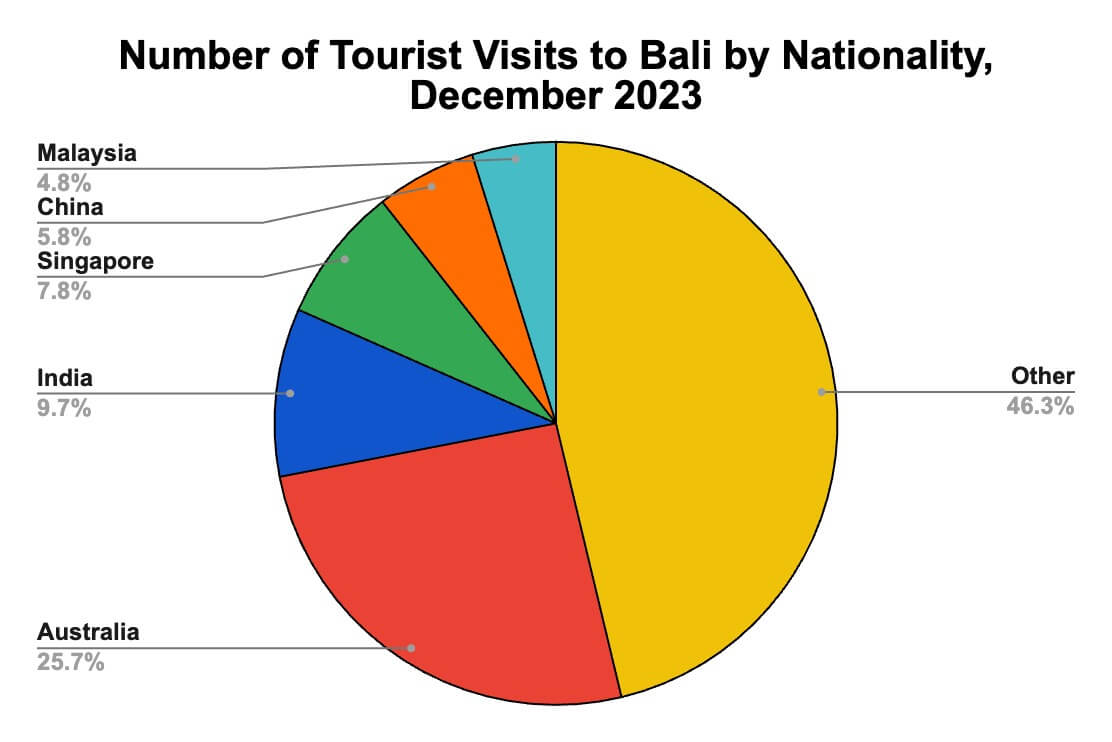
The top five source countries in December 2023: Australia (123,766), India (46,512), Singapore (37,956), China (27,749), and Malaysia (23,212).
Tourists from Australia constituted the largest group, up 15.23% month on month, reflecting Australia's strong tourism ties with Bali.
Indian tourist visits showed a significant increase, up 36.93% month on month, emphasizing Bali’s growing popularity in India.

Tourism by Mode of Transportation
Nearly all (478,382) of the international tourists arrived by air, highlighting the importance of air travel for Bali tourism.
A sharp increase in air travel arrivals in December 2023, up by 20.34% month-to-month.
Sea arrivals accounted for 3,264 visits, showing a decrease of 42.05% month-to-month, indicating a lesser preference for sea travel.
Hotel Occupancy Rates & Average Length of Stay
Star-rated hotels had an occupancy rate of 62.19% in December 2023, indicating a healthy demand for premium accommodations.
Non-star-rated hotels had an occupancy rate of 37.47%, showing a solid demand across different accommodation types.
The highest occupancy rate among star-rated hotels was in 1-star hotels at 65.84%, while the lowest was in 2-star hotels at 54.65%.
Guests in star-rated hotels stayed an average of 2.49 days, slightly longer than those in non-star-rated hotels, who stayed an average of 2.14 days.
Foreign guests stayed longer (2.97 days in star-rated and 2.67 days in non-star-rated hotels) compared to Indonesian tourists (2.07 days in star-rated and 1.56 days in non-star-rated hotels)
The data underscores the diversity in accommodation preferences and lengths of stay among Bali’s visitors.
If you’re planning your visit to Bali, start with our Tours in Bali, which offer a variety of experiences to help you discover the island’s magic.

Impact on Local Economy
The surge in tourism significantly contributes to Bali’s economy, supporting local businesses, from hospitality to retail.
Increases in tourist arrivals drive demand for local products and services, promoting economic growth.
Employment opportunities in the tourism sector have seen an uptick, benefiting the local population.
Tours like the UNESCO World Heritage Sites Tour showcase Bali’s rich heritage, drawing global audiences and boosting revenue for local communities.
The Future of Bali Tourism
The positive trends in tourist arrivals, hotel occupancy rates, and average length of stay indicate a strong recovery and potential for future growth.
Continuous investment in infrastructure and services is crucial to sustaining growth in the tourism sector.
Bali's ability to attract a diverse international audience highlights its appeal as a global tourist destination.
We hope you've learnt lots about tourism in Bali throughout our deep dive into the numbers! If you're interested in getting to know more about the industry in other parts of the world, you should also check out our thorough analysis on Mexico tourism statistics which delves into the country's tourism as a whole and broken down by major hubs.
Recommended Articles


Get your VACATION on!
Expertly curated emails packed full of vacation inspiration, travel tips and more!