+1 617 404 2125
Magellan's Cross




Search


| 📌 Address | 7WV2+CQG, P. Burgos St, Cebu City, 6000 Cebu, Philippines |
| ⏰ Opening Hours | 8:00 AM - 6:00 PM |
| 💸 Entrance Fee | Free |

Magellan's Cross is a cultural and historical landmark in Cebu City, Philippines. Nestled within a chapel just across from the Basilica Minore del Santo Niño, this wooden cross is reputedly the one that Portuguese explorer Ferdinand Magellan planted on the shores of Cebu to mark the conversion of the island's locals to Christianity. Although the original cross is believed to be encased within another to protect it from deterioration, the site remains a symbol of Christianity's arrival in the Philippines.

From bustling bargain markets and colorful jeepneys to authentic Filipino street food and hidden Chinatown treats, our Divisoria & Street Food Dare Tour is perf...
The history of Magellan's Cross is ingrained in the very roots of Filipino Christianity. Ferdinand Magellan, under the Spanish Crown, arrived in Cebu on April 7, 1521. In a gesture signifying the propagation of the Catholic faith, Magellan erected the cross on the island after Rajah Humabon, the local chieftain, and his queen, along with around 400 natives, were baptized into the Christian faith. This event marked one of the first seeds of Christianity in Southeast Asia.
Despite its prominence, many believe the original cross has not survived to the present day. Stories suggest the original cross was either destroyed or disappeared, and that the current cross is merely a replica that encases the remnants. However, the contrast between the legend of its endurance and the actual history of the cross does not diminish its importance as an embodiment of the Catholic faith among the Filipino people.
Magellan's Cross serves as a poignant memorial to a pivotal moment in Philippine history: the arrival of Spanish influence and the introduction of Christianity. It stands as an emblem of a faith that now encompasses a significant portion of the Filipino population. Many Filipinos make pilgrimages to the cross, particularly during Holy Week, exhibiting a tradition of devotion and reverence.
Moreover, the cross represents the beginning of a cultural shift and intertwining of indigenous beliefs with European customs, greatly contributing to the rich tapestry that is Philippine history and identity. Its continued presence attests to the resilience of the Filipino spirit and is a cherished emblem of Cebu City's heritage and the country’s colonial past.
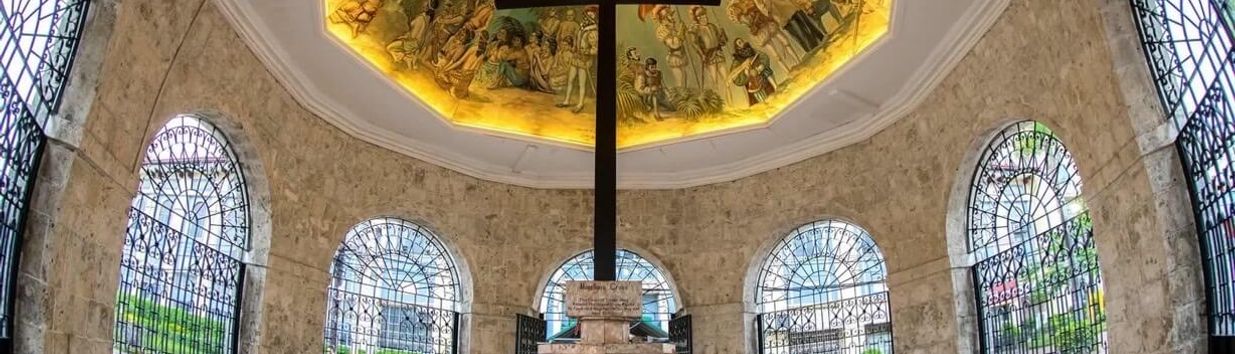
Visitors to Magellan's Cross can soak in the solemn yet uplifting atmosphere that envelops the site. The chapel housing the cross features a beautiful mural on the ceiling that depicts the landing of Magellan in Cebu and the subsequent planting of the cross, offering a visual narrative to complement the site's historical significance. It's a quiet space for reflection and an opportunity to witness an ongoing tradition of prayer and candle offerings by the local devotees.
After visiting the cross, you can explore the surrounding areas, which are rich with historical sites. Immediately nearby is the Basilica Minore del Santo Niño, which houses the revered image of the Child Jesus—a figure as significant to Filipino Catholics as the cross itself. The museum within the Basilica holds artifacts related to the history of Christianity in the Philippines. Beyond the religious significance, the bustling markets and local eateries around the historic district provide an immersive experience into the everyday life of Cebu.
| 📌 Address | 7WV2+CQG, P. Burgos St, Cebu City, 6000 Cebu, Philippines |
| ⏰ Opening Hours | 8:00 AM - 6:00 PM |
| 💸 Entrance Fee | Free |
Magellan's Cross is a historical landmark in Cebu City, Philippines, that houses a Christian cross planted by explorers of the Spanish expedition led by Ferdinand Magellan upon arriving in Cebu in 1521.
Magellan's Cross is located in front of the Santo Niño Basilica in downtown Cebu City, Philippines.
The cross is a symbol of the arrival of Christianity in the Philippines and represents the event when Magellan converted the local ruler, Rajah Humabon, and his subjects to Christianity.
It is believed that the original cross is encased within the current cross on display to protect it from people who chipped away parts of the cross, thinking it had miraculous powers.
Yes, visitors can take photos of Magellan's Cross. It is a popular photo spot for tourists and pilgrims alike.